Entry, stop loss and target: how to read a trade plan
A trade plan fixes four things before you enter: the trigger that confirms the setup, the entry price, the stop loss where the idea is proven wrong, and the target where you take profit. The risk-reward ratio compares the distance to the target with the distance to the stop: risking $15 to make $23 is about 1:1.5.
The parts of a trade plan
- Trigger: the event that confirms the setup, such as a candle closing below a level. Until it happens, the plan is not active.
- Entry: the price where the position would be opened.
- Stop loss: the price where the setup is proven wrong, and the position would be closed to limit the loss.
- Target: the price where profit would be taken, usually the next major level.
- Risk-reward (R:R): the distance to the target divided by the distance to the stop.
A worked example on gold
This is the plan Wick produced for a 5-minute XAUUSD chart, with price at $4,370 inside a descending channel.
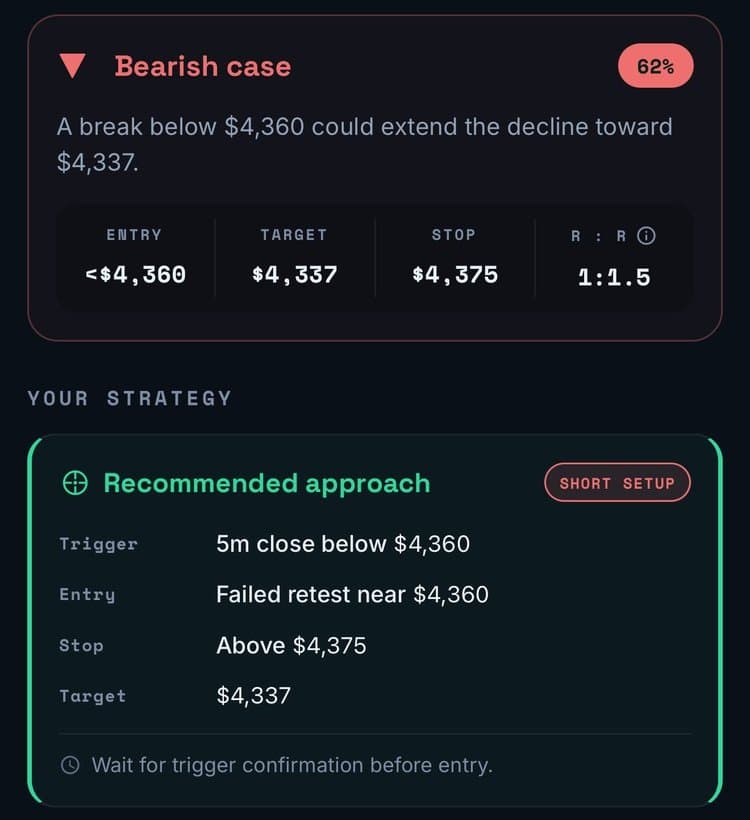
Read it in order. The trigger is a 5-minute candle closing below $4,360, the support level. The entry is a failed retest near $4,360: price breaks down, bounces back to the old support and fails to reclaim it. The stop sits above $4,375, past the level that would invalidate the breakdown. The target is $4,337.
Working out the risk-reward ratio
- Risk = stop − entry = $4,375 − $4,360 = $15.
- Reward = entry − target = $4,360 − $4,337 = $23.
- Ratio = reward ÷ risk = 23 ÷ 15 ≈ 1.5, so the plan is 1:1.5.
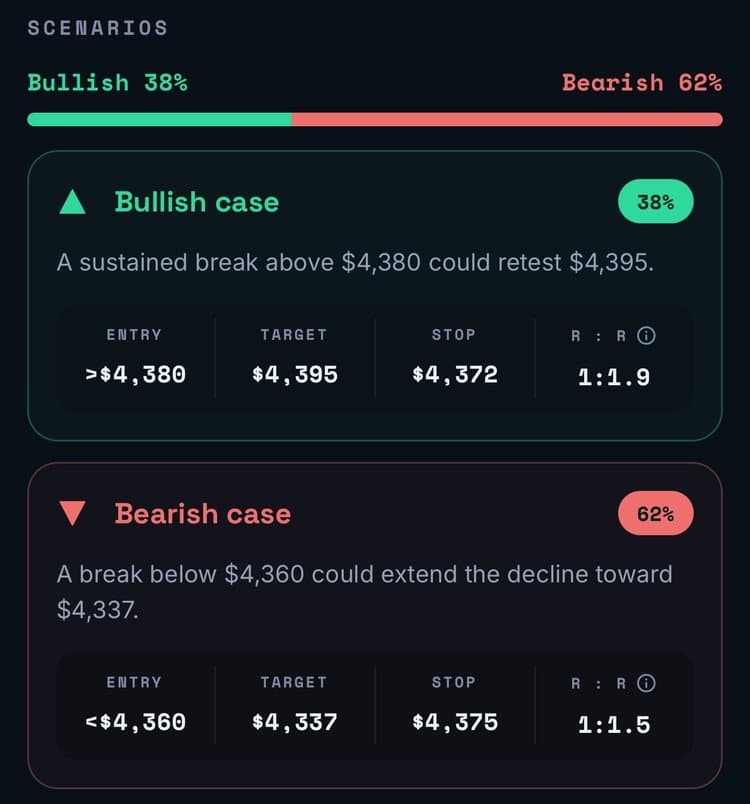
For a long trade the subtraction flips: risk is entry minus stop, and reward is target minus entry. The bullish case on the same chart, with entry above $4,380, stop $4,372 and target $4,395, risks $8 to make $15, about 1:1.9.
The ratio sets the win rate you need. At 1:1.5, a strategy has to be right on 40% of trades just to break even, before spreads and fees.
Why the plan comes with two scenarios
Markets can go either way, so Wick gives both sides with their probabilities, here 62% bearish and 38% bullish. The probabilities are rough estimates, not certainties, and each case only applies once its trigger fires.
Common mistakes
- Entering before the trigger. A plan that needs a close below $4,360 is not active while price is at $4,370.
- Moving the stop further away once a trade goes against you. That changes the risk you planned for.
- Ignoring the ratio. When the target is closer than the stop, every loss outweighs every win.
- Treating a probability as a promise. A 62% case still fails about 4 times in 10.
Frequently asked questions
What is a good risk-reward ratio?
Many traders look for at least 1:1.5 or 1:2, meaning the target is 1.5 to 2 times further away than the stop. A higher ratio lowers the win rate needed to break even, but distant targets are reached less often.
Where does a stop loss usually go?
Just beyond the level that proves the setup wrong: above resistance for a short, below support for a long. A stop set only by a fixed amount of money ignores the structure of the chart.
What does failed retest mean?
After price breaks a level, it often returns to test it from the other side. A failed retest is when price touches the old level and turns away again, which many traders treat as confirmation of the break.
Can an AI app make a trade plan from my chart?
Wick suggests an example plan from a chart screenshot, with trigger, entry, stop, target and risk-reward. It is educational analysis to check against your own read, not a recommendation to trade.
Educational content, not financial advice. Trading involves risk, including the loss of your capital. AI analysis can be wrong; always do your own research. Read the full disclaimer.