
Best ChatGPT prompts for crypto trading and analysis
The most useful ChatGPT prompt for crypto trading gives it a screenshot of the coin's chart plus a strict list of what to return: the pair and exchange, the latest price as shown on the axis, the trend, the levels that matter (round numbers included), a long and a short trade each with its own trigger, entry, stop and target, and the stop distance as a percentage so the position can be sized for leverage. The prompts below cover a full chart read, altcoins against Bitcoin, leverage and liquidation, a news and funding check, scalping and a trade review. To skip the prompt entirely, Wick reads a crypto screenshot in seconds and returns the levels, the odds on each side and a complete trade plan.
Why crypto needs its own prompts
Crypto breaks several assumptions a general chart prompt makes:
- It never closes. There is no opening bell, so you have to tell ChatGPT which candle close counts. Most charts end the daily candle at 00:00 UTC.
- Leverage. Perpetual futures let you trade at 10x or 50x, and the liquidation price can sit closer than your stop.
- Pairs. BTCUSD, BTCUSDT and a coin priced in BTC are different charts with different levels.
- Bitcoin leads. Most altcoins follow Bitcoin, so a long on an altcoin while BTC is falling is a fight against the tide.
- Round numbers. Levels such as $70,000 or $100,000 on Bitcoin, or $1 on smaller coins, draw in orders and attention.
- ChatGPT prompts for trading chart and technical analysisCopy-ready ChatGPT prompts to analyze a trading chart screenshot: trend, key levels, patterns, both scenarios and a trade plan, plus how to check the answer.
Have your account size, your risk per trade and your usual leverage ready. For screenshot basics, see the ChatGPT chart prompts guide.
Prompt 1: the crypto chart read
Upload the screenshot of your coin to ChatGPT and paste the prompt below. Fill in the brackets, or drop them and let ChatGPT take the details from the chart.
Act as a crypto trader who plans every trade before entering. The screenshot shows [PAIR, for example BTCUSDT] on [EXCHANGE], [TIMEFRAME] chart.

1. Confirm the pair, the chart interval and the latest price on the axis. Where something is unreadable, say it rather than filling the gap.
2. Describe the trend and where price sits relative to the moving averages on the chart.
3. List support and resistance as prices from the axis, including any round number the market has respected.
4. Point out any pattern, plus the level that confirms it and the level that cancels it.
5. Build two trades, one long and one short. Give each its trigger (a [4-hour] candle closing beyond a level), entry, stop, target, stop distance as a percentage, and reward-to-risk ratio.
6. Which of the two does the chart support more? Put a rough percentage on each.
7. With browsing on, list any scheduled event in the next 48 hours, such as US inflation data or a large token unlock, that could move this coin.

No price predictions, only what the chart supports.
The stop distance in percent matters more in crypto than anywhere else. It tells you how much leverage the trade can take before the liquidation price gets in the way, and Prompt 3 builds on it.
A real crypto read: Bitcoin on the 4-hour chart
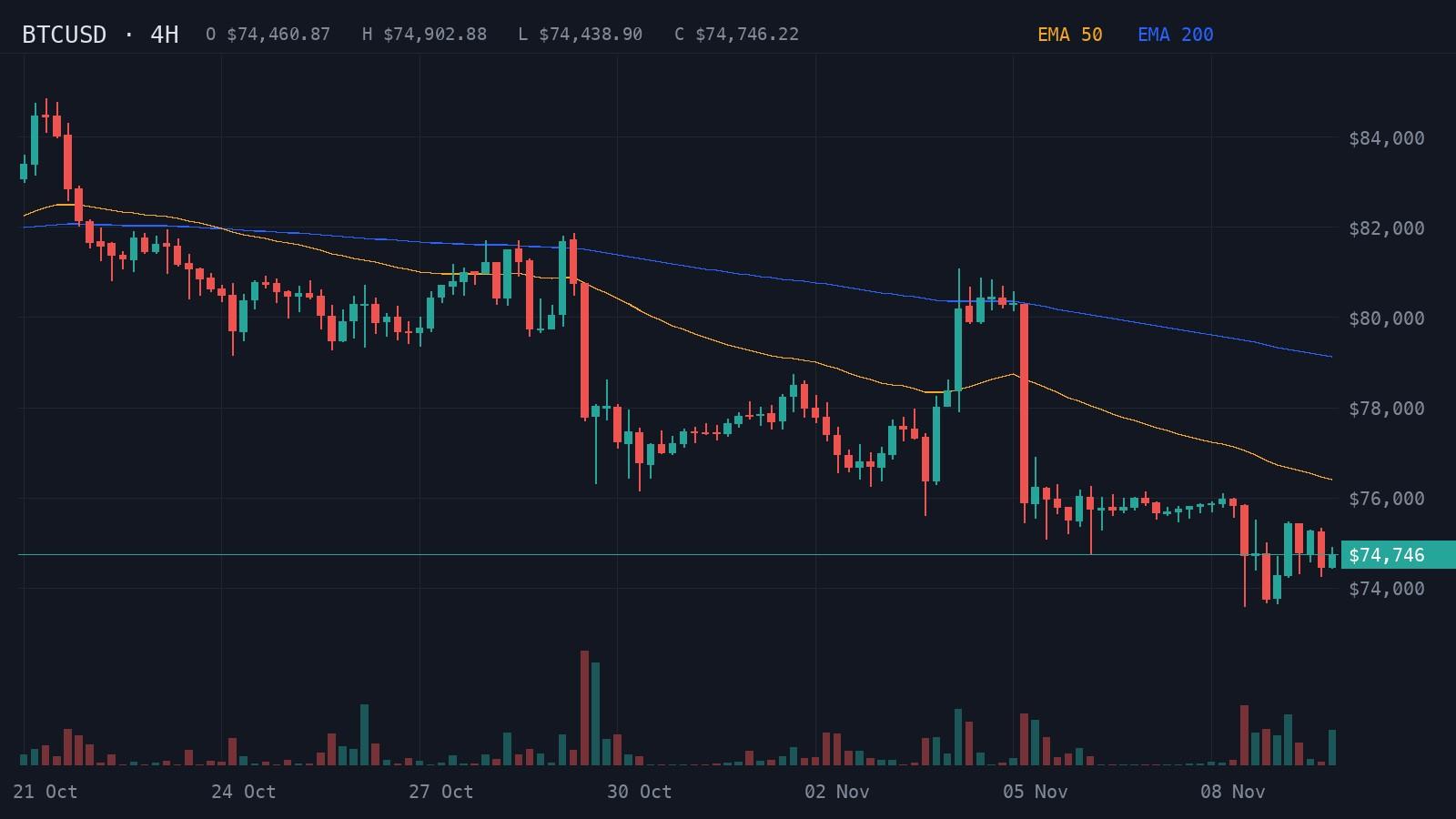
This is BTCUSD on the 4-hour chart from 21 October to 08:00 UTC on 10 November 2026. Bitcoin topped near $84,850 on 21 October, lost 3.7% in a single 4-hour candle on 29 October, rallied to about $81,000 on 4 November and handed it all back the next day with a 5.5% drop. It dipped to around $73,600 on 8 November and was trading at $74,746, under both of its falling averages. We sent the screenshot to Wick instead of writing a prompt.
- Resistance
- $76,000
- Support
- $74,000
- Stop loss
- $75,500
Price is consolidating below declining EMA 50 and EMA 200, favoring downside continuation.
Indicators: EMA 50, EMA 200
A sustained break above $76,000 could target $77,200 after reclaiming the nearby range ceiling.
- Entry
- >$76,000
- Target
- $77,200
- Stop
- $75,200
- R:R
- 1:1.5
A 4H close below $74,000 could extend the markdown toward $71,500.
- Entry
- <$74,000
- Target
- $71,500
- Stop
- $75,500
- R:R
- 1:1.7
- Trigger
- 4H close below $74,000
- Entry
- Failed retest near $74,000
- Stop
- Above $75,500
- Target
- $71,500
Wick saw a bearish consolidation inside a downtrend with 78% confidence and favored the downside 68% to 32%. The short needs a 4-hour close below $74,000, then sells a failed retest, with the stop above $75,500 and the target at $71,500: $1,500 of risk for $2,500 of reward, roughly 1:1.7. On the upside, Wick wants a sustained break of $76,000 toward $77,200, with the stop at $75,200.
That $1,500 stop is about 2% of the entry price. Risking $50 of a $5,000 account, the position is 50 ÷ 1,500 = 0.033 BTC, about $2,470 worth of Bitcoin, whatever leverage you use. Leverage only changes how much margin you put up and how close the liquidation price sits.
The whole checklist from Prompt 1 is there, from the trend to both setups and their odds, without a word typed.
Let Wick read your next crypto chart
Screenshot any pair on Binance, Bybit, Coinbase or TradingView and send it to Wick. Seconds later the same report is on your screen for your own coin: the levels, both sides and a plan you can size before opening the position.
Prompt 2: an altcoin against Bitcoin
Screenshot 1 is [COIN]USDT on the [daily] chart. Screenshot 2 is Bitcoin on the same timeframe.

1. Is Bitcoin trending up, down or sideways, and which level would change that?
2. Over the period shown, has [COIN] been stronger or weaker than Bitcoin?
3. Only if it agrees with Bitcoin's direction, give me a setup on [COIN], naming the trigger, entry, stop and target.
4. If the two charts disagree, tell me which Bitcoin level I should wait for before trading [COIN].
When Bitcoin drops hard, most altcoins drop harder. This prompt makes the Bitcoin check part of every altcoin trade instead of an afterthought.
Prompt 3: leverage, size and liquidation
I trade [BTCUSDT] perpetual futures on [EXCHANGE] with [isolated] margin. Account: $[ACCOUNT]. Risk per trade: [RISK]%. Leverage: [LEVERAGE]x. I plan to [go long or short] from $[ENTRY], with the stop at $[STOP] and the target at $[TARGET].

1. Work out how many dollars I'm risking, how far the stop is in percent, and the position size in coins and in dollars.
2. Calculate the margin this position needs at my leverage.
3. Estimate the liquidation price and tell me whether it sits beyond my stop with room to spare.
4. Include trading fees of [0.05]% per side and show how they change the risk and the reward.

Show every step, and remind me to check the liquidation price my exchange displays.
- Position size calculator for forex, gold, indices and stocksCalculate how many lots or shares to trade from your account size, risk per trade, entry and stop loss. Works for forex, gold, indices, crypto and stocks.
The arithmetic makes one rule obvious: your risk comes from the stop and the position size, not from the leverage. Leverage decides how much margin you tie up, and set too high it lets the exchange close you out before your stop is ever reached. Exchanges calculate liquidation slightly differently, so trust the figure on your order screen over ChatGPT's estimate.
Prompt 4: the news and funding check
This one needs web search switched on.
Search the web and tell me what could move [COIN] in the next [3] days:

- Scheduled US data releases and Federal Reserve events, with times in [YOUR TIME ZONE]
- Token unlocks, network upgrades or exchange listings for [COIN]
- The current funding rate on the major exchanges, and whether it is unusually high or negative
- Any big headline from the last 24 hours

Give the source and time for each item, and stick to what is confirmed.
Funding shows which side is crowded. When it is high and positive, longs are paying shorts to stay in, and a drop can snowball into a wave of liquidations. The rate changes every few hours, so check it on the exchange as well.
Prompt 5: crypto scalping on low timeframes
This is [PAIR] on a [1- or 5-minute] chart, and I'm scalping: in and out within minutes.

1. Mark the nearest round number and the last [4] hours' high and low.
2. Give one long and one short scalp. Keep every stop tighter than [0.4]% of price, and list entry, stop and target for each.
3. My fees are [0.05]% per side. Subtract them and show the real reward-to-risk of each scalp.
4. If neither is worth taking after fees, say "no trade" and name the level to wait for.
Fees quietly sink crypto scalpers. On a 0.4% stop, paying 0.05% to get in and 0.05% to get out costs a quarter of your risk on every trade, win or lose.
Prompt 6: review a crypto trade
Here are two screenshots of [PAIR]: one from when I opened the trade, one from when I closed it. My trade: [long or short] from $[ENTRY] at [LEVERAGE]x, stop $[STOP], target $[TARGET]. I closed it at $[EXIT] because [REASON].

No sugar-coating. Did I enter at a real level? Was Bitcoin moving with me or against me? Was my leverage sensible for the stop distance? Did I move my stop? Name the one habit costing me the most.
Crypto never stops, which makes revenge trading easy. Reviewing each trade before taking the next one is the cheapest way to break that loop.
Where ChatGPT trips up on crypto
- Prices across exchanges. The same coin trades at slightly different prices on each exchange, so a level from one chart can be off on another. Name the exchange.
- The wrong coin. Thousands of tokens share similar names and tickers. Give the full name and the pair, and check its answer is about the right one.
- Stale prices. Without web search ChatGPT has no idea where crypto trades today, and crypto moves fast. Always start from your own screenshot.
- Price predictions. Ask for Bitcoin's price next month and you will get a number, but it is no better than a guess. Ask for levels and conditions instead.
ChatGPT for the homework, Wick for the chart
ChatGPT shines on the work around a crypto trade: the news, funding, leverage arithmetic and the review afterwards. The chart is a different story: that is the one job Wick is designed for. One screenshot gives you the trend, the key levels, bullish and bearish odds and a full trade plan, in one consistent format for every coin, saved to your journal.
A routine that works for many crypto traders: Wick reads the chart, ChatGPT handles the news and the sizing, and the stop decides the position size, never the leverage.
Stop guessing on your next crypto trade
Crypto doesn't sleep, and the next setup on your coin could form at 3 a.m. Be ready for it. Send Wick a screenshot and within seconds you see the level, the side the odds lean toward and the close you are waiting for. Download Wick and trade crypto with a plan, not a hunch.
Related guides
- How to analyze a Bitcoin (BTC) chart with AIScreenshot your Bitcoin chart, upload it to an AI chart analysis app, and read the trend, levels, scenarios and trade plan. A real 4-hour BTCUSD example.
- Best AI apps for crypto analysis in 2026The best iPhone apps for crypto analysis in 2026, compared: Wick's AI chart reads, TradingView, CoinMarketCap, CoinGlass, DEX Screener and CoinStats.
Frequently asked questions
What is the best ChatGPT prompt for crypto trading?
One that hands ChatGPT the coin's chart with a strict list to fill in: pair and exchange, the price on the axis, the trend, support and resistance (round numbers included), long and short trades with their triggers, entries, stops and targets, plus the stop distance as a percentage for sizing with leverage. Prompt 1 above is written that way.
Can ChatGPT predict the price of Bitcoin?
No. A price it gives for next week or next year is a guess presented as a forecast. It can't see future news, and without web search it doesn't even know today's price. What it can do is map out the levels and what would have to happen for Bitcoin to rise or fall. Wick does the same from your screenshot and puts odds on both sides.
Can ChatGPT analyze a crypto chart screenshot?
Yes. Give it a screenshot from Binance, Bybit, Coinbase or TradingView and it will walk through the trend, the levels and any pattern. Check every price it reads against the chart, and tell it the pair and exchange, since prices differ slightly from one exchange to another.
Can ChatGPT calculate leverage and liquidation price?
It can, once you tell it your balance, risk, leverage, entry, stop and fees, and it can also estimate the liquidation price. Exchanges calculate liquidation in slightly different ways, so the price on your exchange's order screen is the one to trust.
Can ChatGPT trade crypto for me?
Not on its own. ChatGPT can't place orders or watch a chart in real time, and bots sold as ChatGPT trading systems deserve suspicion. Use it to plan and review trades, and keep the decision and the order in your own hands.
Educational content, not financial advice. Trading involves risk, including the loss of your capital. AI analysis can be wrong; always do your own research. Read the full disclaimer.