
Best ChatGPT prompts for forex trading and analysis
The forex prompt that works best attaches a screenshot of the pair and tells ChatGPT exactly what to report: the pair, the timeframe and the last price with every decimal, the trend, support and resistance as exact prices, one long and one short trade with a trigger, entry, stop and target each, and every distance in pips so you can size the position. The prompts below cover a full chart read, pip value and lot size, the economic calendar, sessions and spreads, the euro-or-dollar check and a trade review. If you'd rather skip the prompt, Wick reads a forex screenshot in seconds and returns the levels to the pip, the odds for each side and a complete trade plan.
What a forex prompt has to spell out
A prompt written for stocks or crypto misses things every forex trader deals with:
- Pips and decimals. EUR/USD is quoted to five decimals. The fourth is the pip, the fifth a fraction of one, and on yen pairs the pip is the second decimal. Every stop and target needs a pip count, or the lot size can't be worked out.
- Two currencies. A pair moves when either side moves. EUR/USD can fall because the euro is weak or because the dollar is strong, and the answer decides which other pairs move with it.
- Lots, not shares. A standard lot is 100,000 units of the first currency, a mini lot 10,000 and a micro lot 1,000. Position size comes from the stop in pips and the value of each pip.
- The clock. The market runs from Sunday evening to Friday evening through the Sydney, Tokyo, London and New York sessions, and brokers close their candles at different times.
- The calendar. Rate decisions and data releases move currencies more than any chart pattern, and they arrive at known times.
- ChatGPT prompts for trading chart and technical analysisCopy-ready ChatGPT prompts to analyze a trading chart screenshot: trend, key levels, patterns, both scenarios and a trade plan, plus how to check the answer.
Have your account currency, your risk per trade and your broker's name at hand. For how to take a clean screenshot, see the ChatGPT chart prompts guide.
Prompt 1: the forex chart read
Attach the screenshot of your pair and paste the prompt. Replace the brackets with your details, or delete them and let ChatGPT read them off the chart.
Act as a forex trader who writes the plan before placing the order. The screenshot shows [PAIR, for example EUR/USD] on the [4-hour] chart from [MetaTrader 5, TradingView or my broker's app].

1. Confirm the pair, the timeframe and the last price with every decimal shown on the axis. If a digit is unreadable, say so instead of guessing.
2. Describe the trend and where price sits against the moving averages or bands on the chart.
3. List support and resistance as exact prices, and note any round number, such as 1.1000, that price has reacted to.
4. Name any pattern, with the price that confirms it and the price that cancels it.
5. Give me one long and one short trade: the trigger (a [4-hour] candle closing beyond a level), entry, stop, target, the stop and target distances in pips, and the reward-to-risk ratio.
6. Which side does the chart favor? Give a rough percentage for each.
7. With browsing on, list any high-impact release for either currency in the next 48 hours, with times in [YOUR TIME ZONE].

Stick to what the chart shows. No forecasts.
Asking for every distance in pips is what makes the rest of this page work. Prompt 2 turns those pips into a lot size; without them, ChatGPT's levels are just prices.
A real forex read: EUR/USD on the 4-hour chart
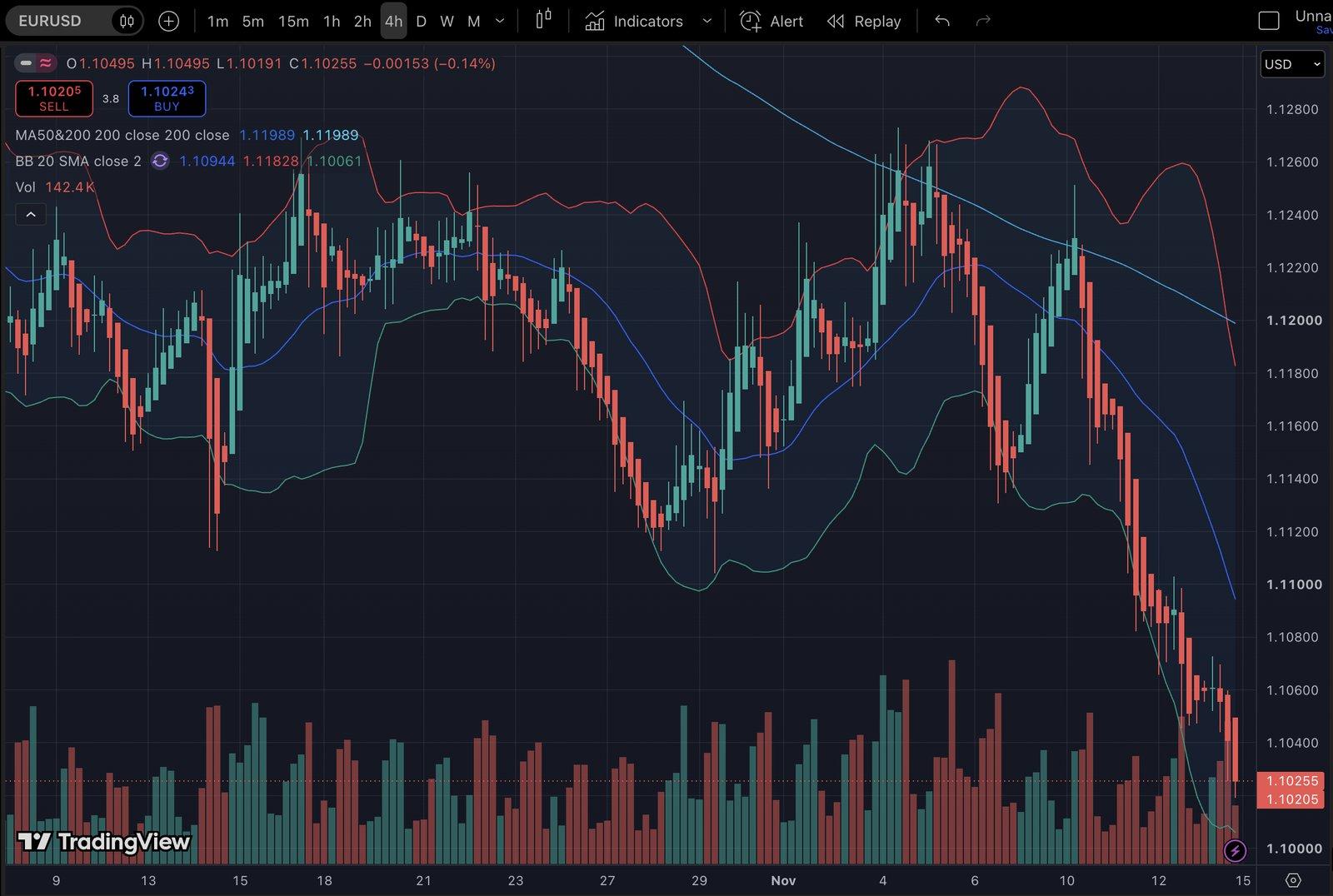
This is EUR/USD on the 4-hour chart in TradingView, from 8 October to the close on Friday 13 November 2026, with Bollinger Bands and the 200-period moving average. The pair spent late October between about 1.111 and 1.126, stalled at its 200-period average twice, near 1.127 on 4 and 5 November and near 1.125 on 10 November, then fell about 230 pips in three days to a low of 1.10191. It closed the week at 1.10255, just above the round 1.1000 and the lower band at 1.1006. We sent the screenshot to Wick instead of writing a prompt.
- Resistance
- 1.1095
- Support
- 1.1000
- Stop loss
- 1.1045
Lower highs and lower lows dominate, with price pressing toward range support.
Indicators: Bollinger Bands, moving averages, volume
A sustained break above 1.1095 could drive a rebound toward 1.1160.
- Entry
- >1.1095
- Target
- 1.1160
- Stop
- 1.1060
- R:R
- 1:1.9
A 4H close below 1.1000 could extend the decline toward 1.0930.
- Entry
- <1.1000
- Target
- 1.0930
- Stop
- 1.1045
- R:R
- 1:1.6
- Trigger
- 4H close below 1.1000
- Entry
- Failed retest near 1.1000
- Stop
- Above 1.1045
- Target
- 1.0930
Wick read a bearish continuation inside a downtrend with 82% confidence and put the odds at 73% to 27% for the downside. The short waits for a 4-hour close below 1.1000, sells a failed retest of that level, sets the stop above 1.1045 and targets 1.0930: 45 pips of risk for 70 pips of reward, about 1:1.6. The long needs a sustained break above 1.1095, with the stop at 1.1060 and the target at 1.1160: 35 pips of risk for 65, about 1:1.9.
At the Friday close, price sat about 25 pips above the short trigger and 70 pips below the long one, so neither had fired. Forex reopens on Sunday evening, and the first 4-hour candle to close after that is the earliest either plan can start.
Sizing the short with a US dollar account: a standard lot of EUR/USD is worth $10 a pip, so risking $50 on the 45-pip stop gives 50 ÷ (45 × 10) = 0.11 lots.
Every line Prompt 1 asks for is in that report, and nobody had to write a prompt.
Let Wick read your next forex pair
Screenshot any pair in MetaTrader, TradingView or your broker's app and send it to Wick. A few seconds later you have the same report for your own chart: levels to the pip, both sides with their odds, and the close that has to happen before you trade.
Prompt 2: pip value and lot size
My account is in [USD] with a balance of [10,000]. I risk [1]% per trade. I want to [buy or sell] [PAIR] at [ENTRY], with the stop at [STOP] and the target at [TARGET]. My broker gives me [30:1] leverage.

1. Work out the stop distance and the target distance in pips. On yen pairs a pip is the second decimal.
2. Work out what one pip is worth on a standard lot (100,000 units), a mini lot and a micro lot, in my account currency at today's rate.
3. Give me the lot size that keeps the loss at my stop within my risk, rounded down to 0.01 lots.
4. Calculate the margin this position needs at my leverage.
5. Add a spread of [1.2] pips and show how it changes the reward-to-risk.

Show each step so I can check it.
- Position size calculator for forex, gold, indices and stocksCalculate how many lots or shares to trade from your account size, risk per trade, entry and stop loss. Works for forex, gold, indices, crypto and stocks.
Pip value is where most forex sizing mistakes start. With a dollar account, a standard lot of EUR/USD or GBP/USD is worth $10 a pip. On USD/JPY, EUR/GBP or any pair whose second currency isn't your account currency, the value moves with the exchange rate, so ChatGPT needs today's rate to get it right. Check its answer with the position size calculator before you place the order.
Prompt 3: the forex calendar for your pairs
Turn on web search for this one.
Search the web and build my forex calendar for [this week]. I trade [EUR/USD and GBP/USD] and I'm in [YOUR TIME ZONE].

- Every high-impact data release and central bank decision for [the euro, the pound and the US dollar], with the time in my zone
- The forecast and the previous figure for each release
- Central bank speeches already on the schedule
- Which session each event falls in

Then mark the windows when I should avoid opening a new trade on these pairs. Give a source for every item.
The US jobs report, inflation figures and decisions from the Fed, the ECB or the Bank of England can move a major pair dozens of pips in minutes, straight through a carefully placed stop. Knowing the times in advance lets you stand aside before the release instead of finding out after it.
Prompt 4: sessions, spreads and candle times
I live in [YOUR CITY] and can trade from [7 p.m. to 11 p.m.] on weekdays. I trade [PAIR].

1. Which sessions (Sydney, Tokyo, London, New York) are open during my hours?
2. Is my pair usually busy or quiet at that time?
3. When does the daily rollover happen in my time zone, and how much do spreads usually widen around it?
4. My broker's MetaTrader server runs on [GMT+2]. At what local times do its 4-hour candles close?
5. Will daylight saving changes in the US or Europe shift any of these times in the next two months?
The last question matters more than it looks. The US and Europe change their clocks on different weekends in March and in October or November, and for those weeks London and New York open an hour closer together than usual. A session plan written in summer can be an hour off for two weeks.
Brokers also run their own server clocks, so a 4-hour candle in MetaTrader can close at a different time from the same candle in TradingView. When a plan says to wait for a 4-hour close, use the platform you trade on.
Prompt 5: is it the euro or the dollar?
Screenshot 1 is EUR/USD, screenshot 2 is the US dollar index (DXY), screenshot 3 is [GBP/USD], all on the [4-hour] chart.

1. Is the move on EUR/USD mostly the euro or mostly the dollar? Point to what in the charts tells you.
2. Does GBP/USD confirm the move or diverge from it?
3. I already hold [a short on GBP/USD]. If I also sell EUR/USD, how much of my risk is really one bet on the dollar?
4. Which of these charts gives the cleaner trade in the direction you favor, and why?
The euro makes up about 58% of the dollar index, so EUR/USD and DXY usually move as mirror images. It also means a short on EUR/USD plus a short on GBP/USD is mostly the same dollar trade taken twice, with twice the loss if the dollar turns.
Prompt 6: review a forex trade
Two screenshots of [PAIR]: one at entry, one at exit. I [bought or sold] [LOTS] lots at [ENTRY], stop [STOP], target [TARGET], and closed at [EXIT] because [REASON]. I [did or didn't] hold it overnight, and the spread at entry was [SPREAD] pips.

Be blunt. Was my entry at a real level or in the middle of nowhere? Was there a release during the trade I should have known about? Did the spread or the swap eat a real part of the result? Did I move my stop? What is the one change that would have improved this trade the most?
Holding a position past 5 p.m. New York time adds a swap, a small charge or credit for keeping it overnight, and most brokers apply it three times on Wednesday night to cover the weekend. On a short-term trade that can turn a small win into a small loss, so it belongs in the review.
Where ChatGPT trips up on forex
- Decimals. A quote like 1.10255 carries a fifth digit, a fraction of a pip. ChatGPT sometimes drops it or counts it as a whole pip, which multiplies every distance by ten. Ask it to quote prices exactly as the axis shows them.
- Broker prices. There is no central exchange in forex, so quotes and candle times vary slightly from broker to broker. Tell ChatGPT whose chart it is reading.
- Time zones. Ask for release times without naming your zone and you may get New York or London time, or times on the wrong side of a clock change.
- Stale news. Without browsing, ChatGPT has no idea what the ECB said this morning. Switch search on for anything about news or the calendar.
- Predictions. Ask where EUR/USD will be next month and you get a number dressed up as analysis. Ask for levels and the conditions that would change the picture.
ChatGPT for the calendar, Wick for the chart
ChatGPT is good company for the work around a forex trade: the calendar, the session times, pip values and an honest review afterwards. Reading the chart is the one job Wick does all day. A screenshot from MetaTrader or TradingView comes back with the trend, the levels to the pip, the odds for each side and a complete plan, in the same format for every pair, and saved to your journal so you can see later how each read played out.
A routine many forex traders settle on: the calendar from ChatGPT, the chart read from Wick, the lot size from the stop, and the order in MetaTrader.
Plan your next pair before you place the order
The next forex setup will form while you're at work or asleep, and it won't wait for you to write a prompt. When you spot it, screenshot the pair, send it to Wick and know within seconds where the trade starts, where it's wrong and how far it could run. Download Wick and trade every pair with a plan.
Related guides
- How to analyze a EUR/USD chart with AIScreenshot your EUR/USD chart from MetaTrader or TradingView, upload it to an AI chart app, and read levels in pips. A real 1-hour example with a trade plan.
- Best AI apps for forex analysis in 2026The best iPhone apps for forex analysis in 2026: Wick reads your chart and plans the trade, plus TradingView, MetaTrader, Myfxbook, FXStreet and more.
- Position size calculator for forex, gold, indices and stocksCalculate how many lots or shares to trade from your account size, risk per trade, entry and stop loss. Works for forex, gold, indices, crypto and stocks.
- Best ChatGPT prompts for gold (XAUUSD) tradingCopy-ready ChatGPT prompts for gold (XAUUSD) trading: chart analysis, scalping, lot size, the US data calendar and trade reviews, with a real example.
Frequently asked questions
What is the best ChatGPT prompt for forex trading?
One that attaches the pair's chart and lists exactly what to return: the pair, the timeframe and the last price to every decimal, the trend, support and resistance, a long and a short trade with trigger, entry, stop and target, and each distance in pips. Prompt 1 above follows that format.
Can ChatGPT predict EUR/USD?
No. Any rate it gives for next week is a guess, and without web search it doesn't know today's rate or this morning's central bank news. It can map the levels and the conditions that would send the pair up or down. Wick does that from your screenshot and adds the odds for each side.
Can ChatGPT read a forex chart screenshot?
Yes. Screenshots from MetaTrader, TradingView or a broker's app all work. Check every price it quotes against the axis, especially the last decimals, and tell it which broker's chart it is, since quotes differ slightly between brokers.
Can ChatGPT calculate pip value and lot size?
Yes, once you give it your account currency, balance, risk, entry and stop. On pairs where your account currency isn't the second currency, it also needs today's exchange rate. Compare its answer with your broker's contract details or the position size calculator.
Can I use ChatGPT as a forex trading bot?
Not by itself. ChatGPT can't watch a chart or place orders, and products that promise automated ChatGPT forex profits deserve suspicion. Use it to plan and review your trades, and keep the decision and the order in your own hands.
Educational content, not financial advice. Trading involves risk, including the loss of your capital. AI analysis can be wrong; always do your own research. Read the full disclaimer.